
Things to Read This Week (3/23/26)
Happy first day of Spring Quarter

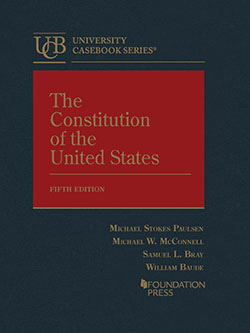
The biggest ticket item this week is the William and Mary Bill of Rights Journal symposium on constitutional law casebooks. Lots of interesting pieces therein, but alas, not one on my favorite constitutional law casebook. You can find a few of my thoughts on that casebook in this old (almost a decade old!) Volokh post, and in the first few pages of my Teaching Constitutional Law in a Crisis of Judicial Legitimacy.
The Writ to Know: Habeas as Supervision, by Will Kamin. I wouldn’t have thought there was an article to write about the right of public access to habeas corpus proceedings, but I was wrong.
Diversifying the Legal Academy, by Brian Fitzpatrick: “Everywhere I turn, I hear university leaders saying we need more conservatives in academia. There is little doubt anymore that they are right: scholars need skeptics to point out research weaknesses; students need provocateurs to help them engage with unfamiliar ideas; we all need balanced academic studies to help us make good public policy. But what I do not hear from many of these leaders is how they are going to do it. I have been thinking about this for many years, and I have some bad news: it is going to be difficult. I canvass the possibilities below and propose massive external pressure as the most promising course.”
That intellectual diversity plan really misunderstands the sense in which we need intellectual diversity. Infinite intellectual diversity is impossible, but it is important that the public can trust that the expert class includes enough people who share their *values* that they can trust that expert claims aren't constructed to disfavor their values [1].
We need a legal academy where republican representatives and other people on the right can feel confident isn't on the side against Trump so they can trust pronouncements about how unpresidented and illegal his actions are. Even if successful that plan won't result in professors the average MAGA voter -- or even maga legislator -- will trust to share their **values** and therefore make the best arguments for the same things they would care about.
That plan gets you people like Baude on the faculty. And while he is great and his legal scholarship no doubt challenges his colleagues he is culturally and in terms of values a member of the cosmopolitan urban elite.
This makes the problem really hard. That's why I think the best answer isn't to (first) guarantee that we have diverse faculty but instead ensure that people can trust that the arguments for what they want would be made if they could. In other words, we need to make it easier to argue for views which most faculty feel have harmful political consequences.
That's why I favor a kind of academic hypocratic oath that includes clauses requiring you speak up on issues related to your expertise even when you don't like the political valence. I'm not naive enough to think it will compell the strong partisans but it will give permission to the people who just want to correct people. For instance, it creates cover to explain why you might poke holes in the legal argument in Roe other than because you oppose abortion.
---
1: For instance, in science, it isn't really enough to know that, say, climate scientists are all telling the truth and doing careful science if you are on the right because you know they aren't motivated to show that climate change might be a net benefit. All changes have positives and negatives so unless you are an expert in the area you have no idea whether you'd expect this many predicted harms even if climate change was net good.
The U.S. Constitution is the first written constitution of a modern nation, while case law is a legal tradition originating in England. Marbury v. Madison set a precedent for judicial intervention in the executive branch, breaking through the limitations of judicial power and demonstrating judicial dynamism. If case law were merely the exclusive power of the Supreme Court and its appellate justices, that would be one thing. However, lower court judges are now creating their own case law, including disregarding federal procedural rules and the United States Code, and abusing precedents. Therefore, the U.S. judiciary is currently in a state of lawlessness.According to the principle of constitutional supremacy, the Constitution binds all federal laws, state constitutions, and state laws. The constitutional status of lower court judges and Supreme Court justices is different; restoring the rule of law requires first limiting the power of lower court judges.