
The Solicitor General's Utility Function
In my latest Interim Docket post, I ponder what drives SG John Sauer's decisions about which Administration losses to bring to the Supreme Court.

This post is cross-posted at the Interim Docket Blog on SCOTUSblog.
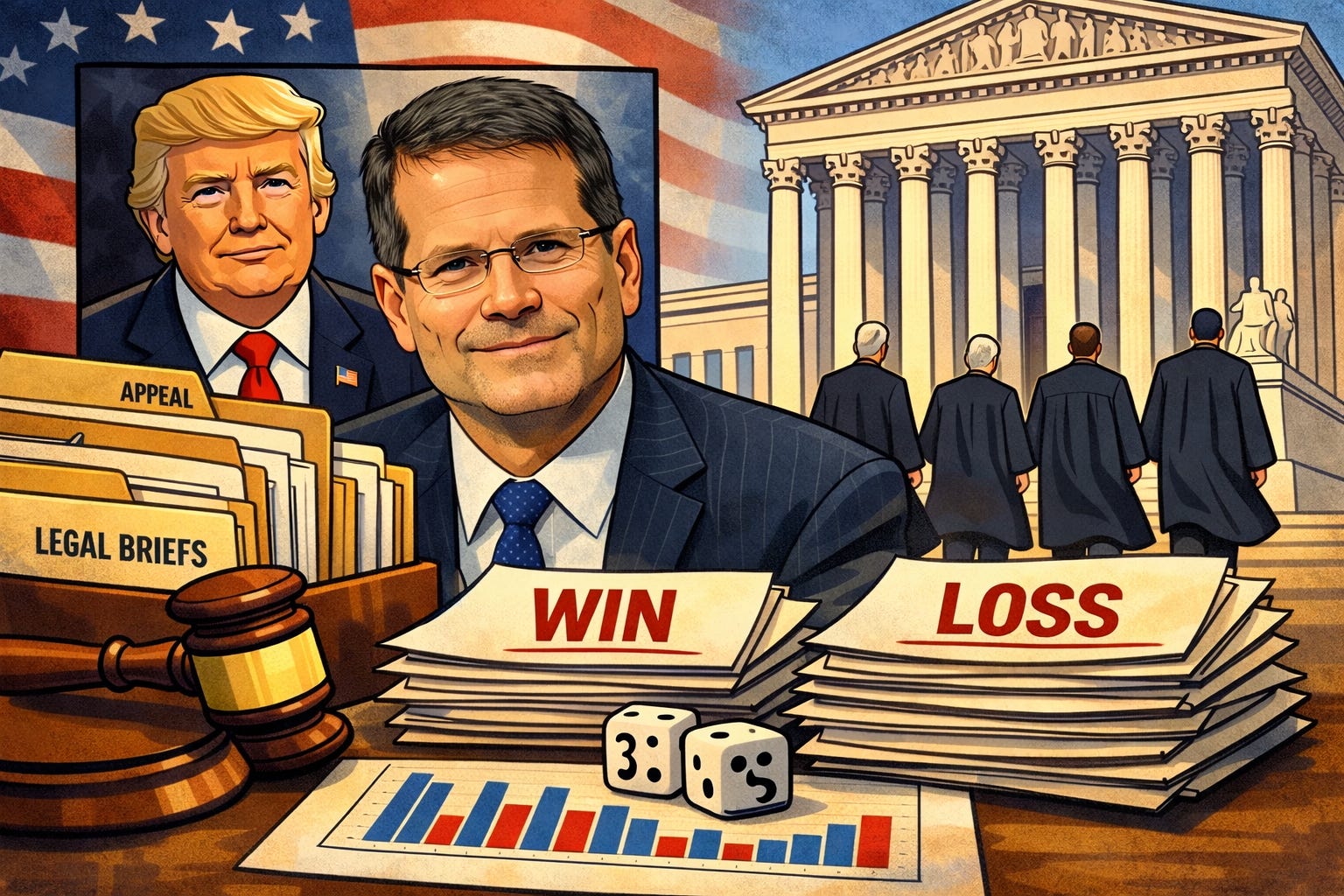
The Supreme Court has taken a lot of heat in recent months over the high rate at which it has sided with the Trump Administration in interim docket cases. In his most recent post, Jack quotes James Comey offering a response to this criticism that Jack and others have made:
The Trump administration only goes to the circuit courts of appeals with a slice of its losses, and then it only asks the Supreme Court to get involved in an even smaller slice, something like a couple dozen out of hundreds of cases. They only ask the Supreme Court to hear cases they think they can win, so not many. All of that adds up to a misleading success rate in the Supreme Court . . . .
I think there’s much truth in this explanation—though at the same time I think there’s certainly something to the critics’ complaints. Even among the endogenously selected subset of lower court government losses brought to the Court, I’ve been dismayed by how much leeway the Court has given the Administration, and in how little weight the Court seems to put on some of the harm to individuals caused by letting some Administration policies remain in effect (for example, in the D.V.D. case).
Here, though, I’m putting that debate to the side. Accepting the premise that the government’s high success rate at the Court is driven by decisions by the Solicitor General’s Office—and SG Sauer himself—we’re still left with unanswered questions. Specifically, what are the determinants of Sauer’s decisions about which issues to bring to the Court?
Put differently—why would SG Sauer want to bring to the Court only those cases for which he believes that the Administration has a very strong chance of success?
Maybe I’m being obtuse, but the answer to that question is not obvious. And I think the answer likely depends on some combination of political, legal, strategic, and personal considerations for Sauer.
Consider a different strategy: what if the SG’s Office went to the Court every time the government lost in the lower courts? The Administration would surely have a worse victory percentage at the Court. At the same time, there has to be some chance that in a few of those cases, even if the legal arguments are not as strong, the Administration would win.
To flesh it out with a simplified and stylized hypo: imagine that the government loses 100 cases in the lower courts. For a subset of these cases (say, 30) the government has particularly strong arguments. If the SG’s Office seeks review of these—and only these—cases, it will obtain reversals of 80% of them—so, 24 victories, leaving in place 76 losses, but a 24-6 record if we only look at the Supreme Court.
What if the government seeks review of all 100 losses though? Imagine that for the other 70 cases, the government’s legal arguments are weaker—perhaps the government has only a 30% chance of winning. Even so, the government would end up with 21 victories in those “weak” cases on top of the 24 wins in the “strong” cases—producing a net record of 45 wins to 55 losses. Isn’t a 45-55 record better than a 24-76 one?
So there needs to be a deeper answer to why SG Sauer doesn’t take the “seek review of everything” strategy. Perhaps the most obvious explanation is limited resources—but I doubt that hat the SG’s Office isn’t so resource-constrained that it’s at the absolute limit of what cases it could ask the Court to review. I think that’s a reasonable assumption, though I recognize that resource constraints must play a role at some point.
The next most facially obvious explanation is credibility. Sauer is playing a long game, and he thinks taking cases to the Court where the government’s legal arguments are weak, he would harm the government’s effectiveness as an advocate in other, more important, cases down the road.
I don’t find that answer totally satisfying, however, for two reasons.
First, I am not sure the Court gives that much deference to the SG’s views of the law. The justices are all pretty confident of their legal views, have competent staffs, and are aided by amici in big cases. I don’t know whether the fact that the government made a legally weak argument in case X last year would actually make the justices less likely to rule against the government on a legal question in unrelated case Y today. (Credibility matters a lot for factual representations by the government, but I’m not sure that applies here).
Second, is there a competing risk that being overly cautious is actually hurting the government? The conservative majority is surely aware of the drumbeat of criticism arguing that they’re in the bag for Trump. One doesn’t have to be a total legal nihilist to think that, on the margins, the justices historically seem to have some impulse to split the difference—to temper wins for one side in the most politically divisive cases with a few losses. At the same time, there’s also reason to think that the Court recognizes it has finite political capital. The more the Court pushes back on the Administration, the greater the risk that the Administration pushes back on the Court.
Combining those observations, it seems to me that if you’re the government, one sensible strategy would be throw everything at the wall and see what sticks, on the assumption that (1) you’re going to lose some no matter what but (2) the Court may not feel comfortable ruling against you too much.
That’s obviously not the strategy this SG’s Office has pursued. Perhaps that’s because I’ve incorrectly weighed the costs and benefits (or, at least, maybe people in the Administration weigh them differently). But there also could be personal political calculations informing Sauer’s decisionmaking. Perhaps Sauer’s concerns for his own personal credibility with the Court as a litigator don’t fully line up with what’s in the interest of the government as litigant. Or perhaps the political dynamics behind the scenes mean that losses before the Court are perceived as particularly costly (and thus threatening to Sauer’s job security).
In any event, this line of inquiry calls to mind an old adage: “If you’ve never missed a flight, you’re probably spending too much time in airports.” Despite the stunningly aggressive legal positions this Administration is taking as a general matter, is it somehow possible that the government is being too cautious when it comes to the Court?
It's interesting to compare Sauer's cases at SCOTUS to the criminal prosecutions of political opponents, where the administration's strategy really has been to throw everything at the wall and see what sticks. Including laughably weak cases against democratic legialators, James Comey, and Letitia James.
One hypothesis is that Sauer wants to win cases to maintain the public appearance of strength, rather than credibility with the court. I don't think the political criminal prosecutions have been beneficial for the administration. They look like clowns and haven't gotten anything done, and I'm pretty sure Mark Kelly and company have actually net benefitted, politcally. It's possible these prosecutions still have a chilling effect, but I tend to think they instead reveal that Trump does not have as much power as he claims he does.
In contrast, the winning record at SCOTUS creates the appearance that the court is aligned with the president, which is a political strength. I see a lot of people just assume the court will endorse whatever Trump is proposing, even in issues like birthright citizenship or federal control of elections where closer court watchers know he'll probably lose. Or alternatively, a strong record at SCOTUS makes Sauer look good within the executive branch, helping his own standing. He looks far more competent than Bondi, for instance.
Also worth noting the worst cases for the administration all arises because of Trump's buggest personal fixations. Vengance against his perceived enemies, birthright citizenship, tariffs, deploying the National Guard. On the cases that Trump isn't paying attention to, where Sauer has more tactical freedom, it seems reasonable for him to decide it's better to avoid losses, rather than eking out a few more marginal wins
"Put differently—why would SG Sauer want to bring to the Court only those cases for which he believes that the Administration has a very strong chance of success?
Maybe I’m being obtuse, but the answer to that question is not obvious. And I think the answer likely depends on some combination of political, legal, strategic, and personal considerations for Sauer."
As a 33 year veteran of DOJ Civil/Appellate who worked with every SG Office from Reagan through Obama, I can confidently say that what Sauer is doing is no different than what any other SG did during that time period. Every SG is concerned with the credibility of the Office, including the credibility of legal arguments. No one in that Office wants to get hammered during oral argument.