
Misunderstanding the Law of the Clean Power Plan Ruling
clarifying irreparable injury


There has been a lot of commentary on the recently leaked Clean Power Plan memos. Here, we want to engage with a couple of points about the law applied by the Court. Specifically, we want to isolate two widely repeated arguments that seem to us to be wrong or at least far more contestable than many commentators have let on. The first is about irreparable injury and the second the overall standard of review.
I. Irreparable Injury and the Government’s Interests
Several eminent commentators have made the criticism that the memos reflect a specific instance of hypocrisy: Whereas the Court now routinely affords the government automatic irreparable injury when its laws or policies are obstructed by court order, that precept went unmentioned in the leaked memos.
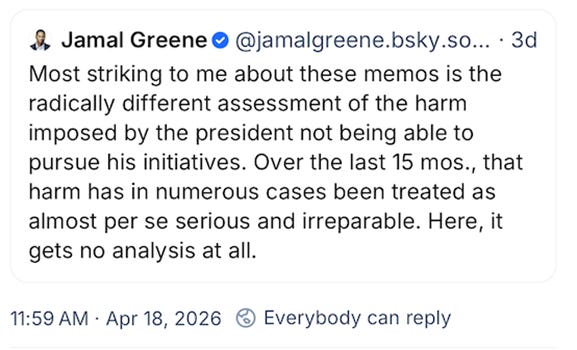
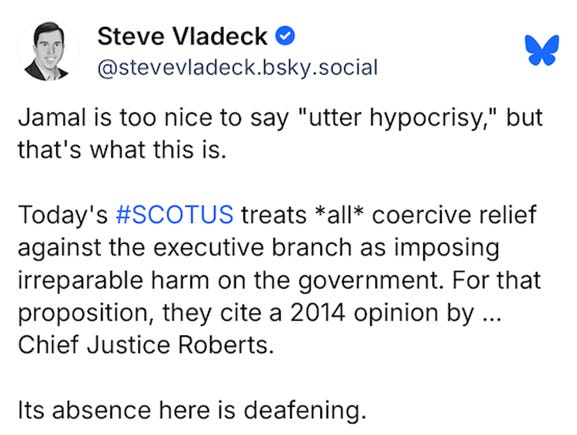
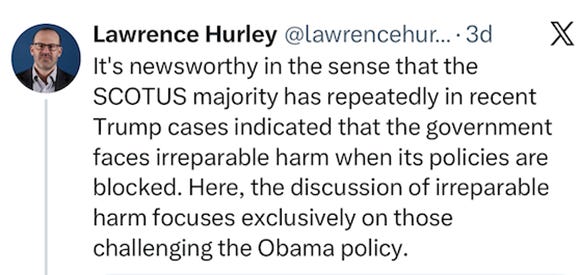
The problem with criticisms like these is that they conflate two different legal doctrines. The Court has stated a rule that the government faces irreparable injury when its policies are blocked. But that is a rule that applies to the moving party. That is, when the government seeks to have a lower court order lifted, it is almost axiomatic that the lower court order injures the government, so the Court focuses on other factors, such as the merits of the case.
This rule had no application in the Clean Power Plan case because the Obama Administration was not the moving party. Instead, the challengers to Clean Power Plan were the moving party: they were the ones seeking a stay.
Now one could instead make a different, more nuanced and less doctrinal claim, that regardless of the technical doctrines at issue, the Court should exhibit a consistent level of concern for the interests of the federal executive branch. The Court should not favor the interests of preferred presidents or executive branch policies. This is, we emphasize, a different point. And it would have been much harder for critics to show that the Court failed to live up to that standard in the Clean Power Plan case.
For instance, the Chief Justice’s memo did explicitly consider it appropriate, based on case law, to balance the equities, but only if the case were close. Presumably consideration of the government’s interest could come into play at that stage. However, he argued in effect that the case was not relevantly close. Additionally, it is hard to compare the various cases across administrations without considering the way they are driven – perhaps appropriately – by the justices’ views of the merits.
The Court’s critics could of course argue for doctrinal reform. Perhaps the standards for interim and preliminary relief should be less merits-focused, or less focused on the movant’s injury and more focused on a more general form of equitable balancing. In a recent lecture, Justice Jackson argued for something like this kind of reform—though even she asked rhetorically in the Q&A (at 1:09): “How could you be harmed from being stopped from doing something you’re not allowed to do?”
We might favor some related reforms ourselves. But that possibility provides little reason to criticize the by-the-book treatment of the issue in the leaked memos; and still less reason for confusing the public about how this area of the law works.
2. The Overall Standard of Review
Another criticism is that the Chief Justice’s memo clearly applied the wrong standard of review. Here, too, the critics are at best overstating their case. The factors applied by the Chief Justice were sensible ones drawn from prior cases and the briefing before the Court.
And, notably, for all of the internal pushback from the dissenting justices, they did not push back on the standard of review. Perhaps this is because the details of the standard of review do not matter so much. In a somewhat novel case, any relevant substantive points can be channeled into the plausible alternative standards of review as well.
In our view, the proper legal analysis for cases like this one is not entirely clear—either at the time that the Court decided or today. Even the relevant legal authority for the Court’s action is unclear. Is it the All Writs Act? The stay provision of the Administrative Procedure Act? Something else?
Some authorities indicate that the test ought to be indisputable clarity. But it is not clear, so to speak, that the Court had adopted that test, and the justices had already seemed to dispense with it in an earlier ruling. One of us wrote a blog post on this topic back in 2014; and the other of us repeated the point in a 2015 article (called … “The Supreme Court’s Shadow Docket”)—both published well before the Clean Power Plan ruling in 2016.
Instead, the Court applied its normal equitable inquiry, citing both the general standard for a stay pending appeal and the standard for stays of administrative action set out in Nken v. Holder. These two standards are really applications of the same underlying principles. Both standards focus on a likelihood of success (which in this context includes an assessment of certworthiness) and irreparable injury to the moving party. The Chief Justice squarely addressed those critical points. When the government is a party, these standards also allow consideration of the balance of the equities in close cases. And the Chief Justice not only noted that point, but also had a clear view as to how it applied, particularly given the threat that he perceived to the Court’s authority.
If anything, the fact that the applicable standard of review was not entirely clear probably supported the justices’ decision not to publish their opinion. As often happens, the justices were still working out legal questions. That circumstance frequently counsels caution about elaborating seemingly firm legal principles or conclusions.
Perhaps the Court was wrong to rely so much on the likelihood of success, especially at such an early stage of the proceedings, and to be so concerned about the executive branch’s efforts to circumvent the judiciary. At the same time, those considerations are hardly unique to the Clean Power Plan case and they have reemerged when the justices faced other cases of fast-moving executive branch overreach. Take AARP v. Trump or the Illinois National Guard case.
Or perhaps critics simply disagree with the ultimate judgments the majority reached. That is fine, but a very different point from whether the memos reveal basic doctrinal errors or hypocrisies, which we doubt.
* * *
There is plenty of fodder to criticize in the Court’s shadow docket rulings over time and even the ultimate result as to the Clean Power Plan application. But what we learned from the memos was some insight into the Justices’ reasoning in this specific case, and frankly, that reasoning makes the Court look better than many of its critics.
Glad comments are back!
Has the court ever explicitly explained or blessed this defense of appellee vs appellant? Or is this just you two trying to come up with an explanation? (I.e. we are left to rationalize the courts behavior in the shadows)
I think there's still a big broader point to address which is that in this situation the chief was taking a more aggressive and conservative position while relying on facts outside the record and relying on factors (money damages) that aren't typically described as irreparable harm. I take this as a large data point against the chief being a moderate or someone who calls "balls and strikes" (a metaphor I've loathed since I first heard it).
As smarter commentators have pointed out, I wonder how much of the particular arguments, missing arguments, and language style is just due to the fact that it seems most everyone is just fighting over getting Kennedy's vote.
So the argument is that the Chief Justice should have (and maybe implicitly did) consider the equities, as required, but thought the merits were so clear that he didn't really have to (i.e., consider the harm to the federal government)? That doesn't really make sense to me. Where does the "in a close case" qualifier come from (not from Nken, certainly)? What is the point of having factors if they can be ignored/read-out of the test at will?